Wargame Mechanics Index

Multiplayer structure

Rules for teams or many players.

Open in the index

Watch it played 4 moments

  • 2:20–2:41
    Join Our First Campaign!
    Little Wars TV
    Rule explained Patrons elect consuls in Roman Senate

    The hosts describe the interactive campaign voting mechanic where patrons serve as the Roman Senate, electing a club member to command field armies each turn based on consular campaign speeches.

  • 9:05–9:42
    Epic Agincourt Wargame
    Little Wars TV
    Rule explained Competitive multiplayer French command structure explained

    Tony explains the scenario format pitting one English player against three French players, where French victory points are scored individually to simulate historical factional rivalry.

  • 15:45–16:35
    Snappy Nappy Rule Review
    Little Wars TV
    Rule explained Multi-table grand tactical battles

    Tony explains that Snappy Nappy is designed for multi-player games spanning several tables simultaneously rather than single-table battles. The rulebook section on multiple tables and footage from their Marengo game are shown.

  • 22:20–26:33
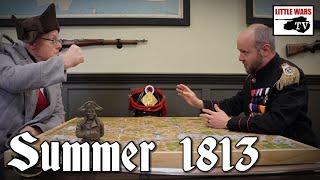
    11-Player Napoleonic Campaign | Summer 1813
    Little Wars TV · Volley & Bayonet
    Tactical decision Coalition strategy conference plans fall offensive

    The Coalition players gather around the 3D relief campaign board to analyze their peripheral deployments and coordinate an operational defense against Napoleon.

Moments picked automatically, by AI watching the video or reading its captions, and linked at the timestamp on YouTube. Quotes are from the captions.

How games do it 16 games

3scen
All players are officers on Side AScience Versus Pluck (designer's overview)

All players cooperate on the Imperial side under an overall commander against the umpire.

How it works

Players receive identities and objectives (sometimes written and complex), plan together, and the overall commander makes key decisions which subordinates are expected to follow.

If, however - as in Science Versus Pluck - all the players are officers on Side A, it becomes much more interesting.
Download · p. 7, 8 Quote verified
2scen
Players and Pilots / The Fluid GameCanvas Eagles

Unlimited players each fly one aircraft, and a convention 'fluid game' lets players drop in and re-enter continuously.

How it works

There is no limit on players. In the fluid game, entry hexes 1-6 behind each trenchline are rolled; shot-down or departed players return after 2-3 turns (1d6), and the most XP wins at the end of the session.

The advantage of the fluid game is that new players may join the game at anytime without having to wait for a new game to begin.
Download · p. 5, 27, 28 Quote verified
2scen

Two Union players roll each turn to see who controls Shields' Division.

How it works

One Union player is Banks, the other Fremont; each turn both roll a die to decide who controls Shields' Division, simulating poor Union cooperation.

they would each roll a die every turn to determine who would control Shield's Division for that turn.
Download · p. 43 Quote verified
2scen

Large games split each side into a commander and subordinate commanders with staff roles.

How it works

About 6 battalions a side need one player each; 24+ battalions need at least three per side, one taking overall command by agreement or lot and assigning advance guard, wings, reserve, artillery or staff roles. At most 4 persons per side move blocks; others act as staff officers. Players more than 1000 paces apart may only communicate via the umpire.

Die Bewegung der Truppenzeichen kann auf jeder Seite höchstens von 4 Personen geschehen.
Download · p. 20, 45, 46 Quote verified
2scen

Each player is a historical personage with an individual, sometimes non-military victory condition.

How it works

Roles include Marshal de Saxe, William of Orange, Governor Cronstrom, Cumberland, Villeroi, Lowendahl, Commissioner Le Clerk (make three profitable business deals) and Villars (do not lose the guns), each with an order of battle.

Commissioner Le Clerk - You are a rich merchant from the town of Lille.
Download · p. 154, 155 Quote verified
2scen
Scalable systemReal Time Wargaming

Designed to scale from 2 to 20+ players simultaneously.

How it works

Because all players act at once, adding players does not add waiting time; multiple Commanders per player and many players per side are supported. A 12-player Waterloo is cited.

Scalable system 8.,. so it can play with two people, but also with 20+ (or more!)
Download · p. 2 Quote verified
2scen
Captains (one piece per player)The Jane Naval War Game

Each player fights exactly one ship, under admirals and governments.

How it works

It is an essential condition that no player has more than one piece. The strategical game adds 'government' players who manage costs and supply, admirals directing strategy, captains fighting single ships, and a player for colliers and merchantmen.

It is an essential condition of the tactical game that no player should have more than one piece.
Download · p. 5, 17 Quote verified
2scen

Each non-emperor player must issue one battle invitation per round.

How it works

Rounds last two to four weeks of real time. Non-emperor players must issue an invitation (defaulting to the emperor); the emperor may issue one after receiving others. Every player must fight at least one battle per round or opponents who invited them are counted as winners.

Players must play at least one battle per round; failure to do so will result in any and all opponents who issued an invitation to that player (or received an invitation from that player) being considered to have won a battle.
Rules PDF · p. 3 Quote verified
1scen
Multi-player corps commandA Wee DRAM of Napoleon

Designed for several players each commanding a corps or larger formation.

How it works

Players are generals of corps or larger formations, so a big battle fits in an evening with 2-8 players. The Ligny game took 3 to 11 players, from just the commanders-in-chief up to every corps commander.

DRAM was originally conceived as a means of enabling small numbers of players (say 2-8) to fight, to a conclusion in an evening, any of the significant continental battles
Download · p. 7 Quote verified
1scen

Built for convention play with players splitting commands.

How it works

Three to five players split the Texian command; each of the four Mexican columns deploys from a table corner, ideally with one player each. Mexican players compete with each other for VPs.

Anywhere from 3-5 players could split the Texian command as they see fit. The Mexicans deploy one “column” from each of the four table corners, ideally with 1 player controlling each column.
Alamo Ruleser · p. 1 Quote verified
1scen

Each player rules a country and engages in diplomacy, alliances and plots.

How it works

Players each become the ruler of a country on a shared map (Gaul, Rome, Greece, Persia, Assyria, Egypt, Carthage plus island countries). Interaction is through proposed alliances, dirty tricks and declarations of war in their yearly orders.

I organized an ancient campaign in which my buddies each became a ruler of a country.
Download · p. 47 Quote verified
1scen
Player rolesDunn-Kempf

Players fill real command positions within each team.

How it works

Each side is a team with players as company and battalion commanders, platoon and section leaders, forward observers and fire support coordinators, with a separate controller and an optional time limit on orders.

players are selected for opposing forces company and battalion commanders, platoon leaders, section leaders, forward observers, fire support coordinators, etc.
Download · p. 7 Quote verified
1scen

Up to six players each run their own HQ.

How it works

Each side has three commands with their own HQ sheets, operations dice and regiments. Chinese players each act before the Allies alternate at night, and the reverse by day.

There are unique commands for up to six players.
Download · p. 3 Quote verified
1scen
Teams and larger battlesLittle Wars

Larger games with multiple players per side and a commanding general are suggested.

How it works

Each player should handle about a hundred men and three guns; with teams one could have a general controlling the campaign with divisional commanders. The Kriegspiel appendix envisages each arm entrusted to a particular player.

with a team of players and an extensive country, one could have a general controlling the whole campaign, divisional commanders, batteries of guns, specialised brigades
Download · p. 35, 39 Quote verified
1scen

Romans and Mamertines face Carthaginians and Syracusans, with allies not counting as close allies.

How it works

Each player fields 700 points under muster requirements; the Fields of Blood multiplayer rules are recommended. The winner of scenario 1 gains an extra fate point in scenario 2.

This is a four-player game; all forces must observe the muster force requirements (no ad-hoc forces allowed).
Download · p. 41, 42 Quote verified
1scen

Two or more players take phases in initiative order clockwise around the table.

How it works

Any number of players can take part, acting in clockwise initiative order each phase; Rune cards stay secret even from allies in team games, and several scenarios are for three or more players.

Ravenfeast can be played with two or more players on any size table, with any scale models.
Download · p. 13, 23 Quote verified